

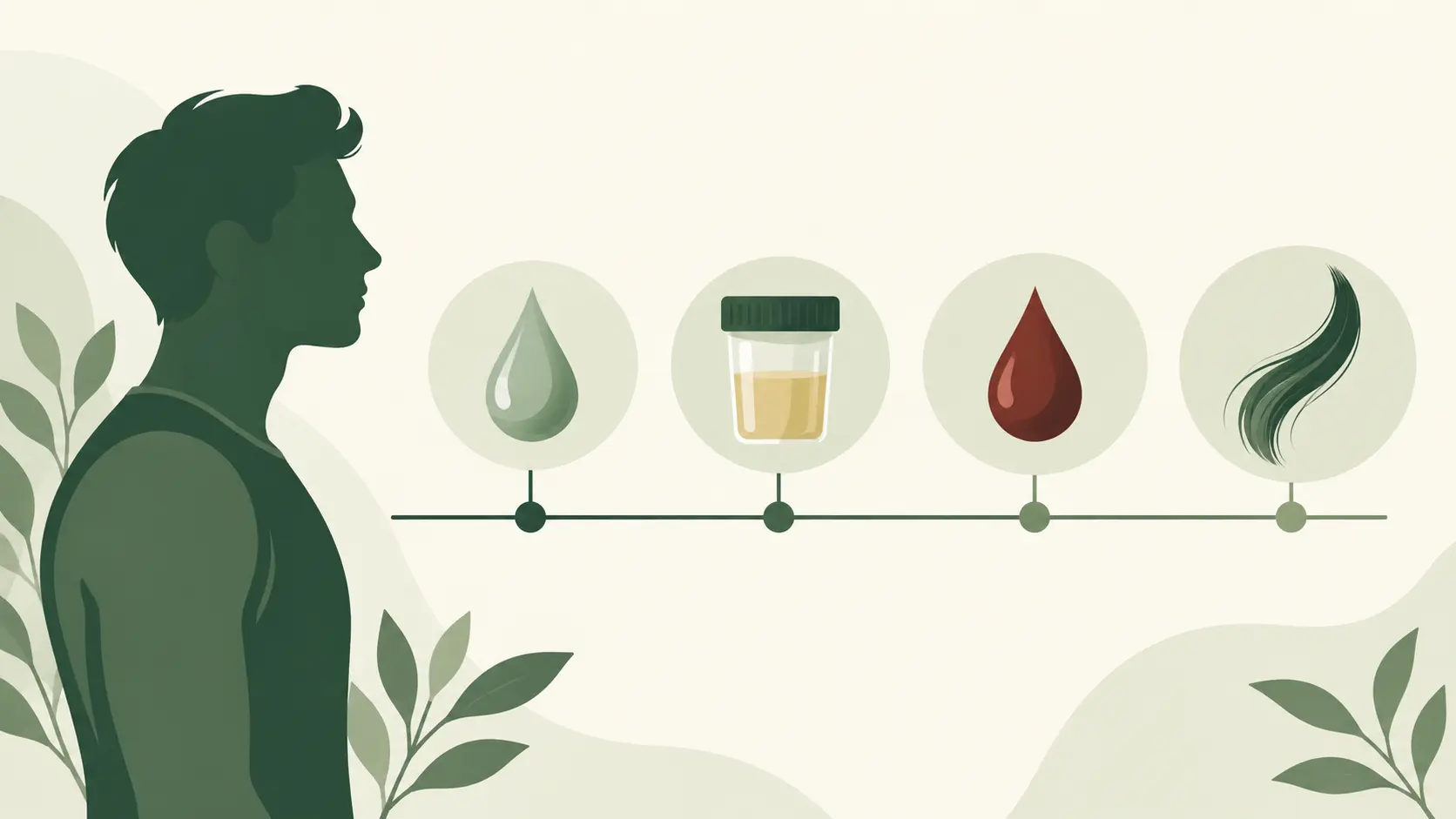
It depends on the test and, above all, on how often you consume. As a general reference, THC in saliva is usually detectable for 24 to 72 hours (longer with daily use), in urine for 3 to 7 days after occasional use and 30 days or more in regular consumers, in blood only a few hours in its active form, and in hair for up to 90 days. These are reference ranges: every body clears it at its own pace. And one detail that changes everything: being detectable does not mean you are still feeling any effects.
This question tends to come up exactly when it matters most: before a workplace medical check, when planning a trip, or simply because you want to know what happens inside your body after consuming. The answers floating around the internet range from “a couple of days” to “three months”, so the confusion is understandable.
In this article we put some order into it: the reference detection times for each type of test, the factors that actually move them, and the myths worth clearing out of your head, because some of them can work against you.
Important note: at Green City we do not promote cannabis use. We are a private non-profit association formed by adults who are already consumers. This article is for information purposes: knowing how THC behaves in the body is part of responsible, informed consumption. It does not replace advice from a healthcare professional.
In this article
Why THC stays in your body for so long
The key is one word: fat. THC is a fat-soluble molecule, which means it dissolves in fat rather than in water. While alcohol, being water-soluble, leaves the body within hours, THC gets stored in fatty tissue and is released back into the bloodstream little by little, over days or weeks.
There is a second player almost nobody talks about: THC-COOH. When the liver processes THC, it turns it into several metabolites, and this is the main one. It is not psychoactive (it does not get you high), but it stays in the body far longer than the original THC, and it is exactly what most urine tests look for. Put simply: tests rarely measure whether you have active THC in you; they measure the traces it left behind. If you want a refresher on what THC or a cannabinoid actually is, both are explained in our cannabis glossary.
Detection times by type of test
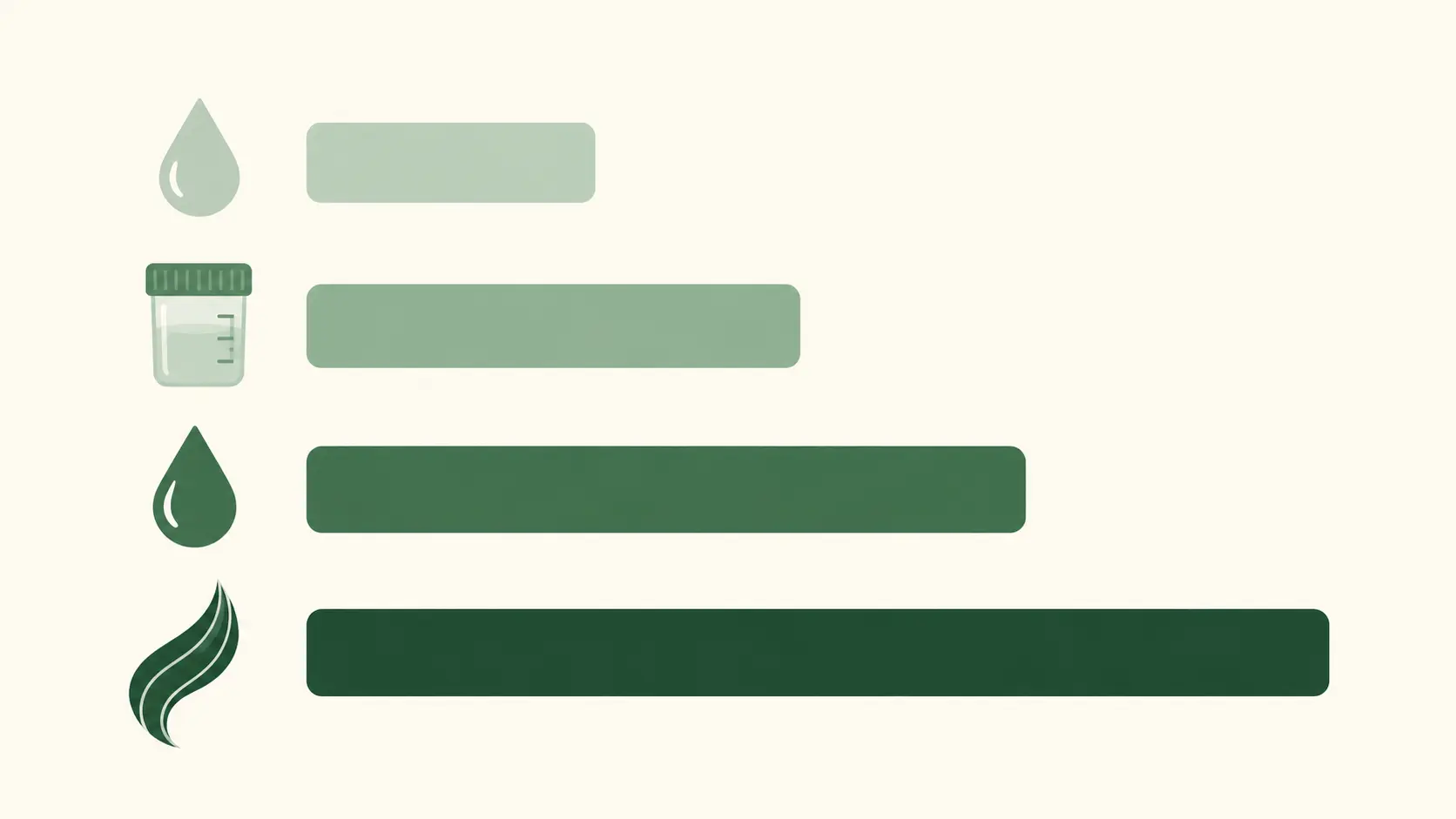
Each type of test measures different things in different places, which is why the times vary so much. This table sums up the reference ranges found in the scientific literature. We insist on the word reference: some people test negative sooner, and there are documented cases that go beyond these margins.
| Type of test | Occasional use | Regular use (several times a week) | Daily use |
|---|---|---|---|
| Saliva (detects active THC) | 24 to 48 hours | 48 to 72 hours | Up to a week in heavy use |
| Urine (detects THC-COOH) | 3 to 7 days | 7 to 15 days | 30 days or more; up to 60-90 documented in very prolonged heavy use |
| Blood (active THC) | A few hours (the peak drops fast) | 12 to 24 hours | Low levels detectable for days |
| Hair (consumption history) | May not register at all | Up to 90 days | Up to 90 days (3 cm of hair) |
Two notes on the table. First: the saliva test is the one used in roadside drug checks in Spain and, increasingly, by employers, because it detects active THC and points to recent use. Second: the hair test has the longest window but is rarely used in Spain, and it comes with an important limitation: it shows there was consumption in recent months, but neither when nor how much.
The factors that actually move the clock
The ranges in the table are wide because THC clearance depends on very personal variables. These are the four that weigh the most, in this order:
Frequency of use
The dominant factor, by a wide margin. The body of a daily consumer stores THC in fat faster than it can clear it, and that reserve takes weeks to empty. After one-off use, the body starts almost from zero.
Body fat and metabolism
More fatty tissue means more capacity to store THC and a slower release. And every metabolism works at its own speed: two people with identical consumption can get different results on the same test.
Amount and potency
One puff of a mild strain leaves a very different trace than a long session with high-THC flower. A higher total dose means more metabolites to clear and more days of detection window.
How you consume
Smoked or vaporised, THC reaches the blood quickly and also starts clearing sooner. Taken orally, the whole process stretches out: effects take longer to arrive and metabolites build up more gradually, as we explain in our article on cannabis edibles.

Myths about “flushing it out fast”
A whole industry of quick fixes has grown around this question. Here is what the evidence says about each one:
- Drinking huge amounts of water. It does not speed up THC clearance; at most it dilutes your urine that day. Labs check for this (they measure creatinine), and an over-diluted sample is usually flagged or repeated.
- Detox juices, vinegar and miracle supplements. No scientific backing. THC-COOH leaves the body at the pace your liver sets, and no juice changes that chemistry.
- Sweating it out or intense exercise right before a test. There is even a little-known opposite effect here: exercise mobilises fat and can release stored THC, temporarily raising blood levels. Regular exercise is good for overall health, but as a last-minute trick it can backfire.
- “One puff won’t show up”. It depends on the test and the timing. In saliva, recent one-off use is detected without trouble during the first 24 hours.
- Other people’s smoke. Testing positive from passive exposure is very unlikely under normal conditions. It would take a closed, unventilated space and intense, prolonged exposure to get anywhere near detection thresholds.
Time
There is no shortcut: the detection window only shrinks by letting days pass without further use. Everything else is noise, and part of that noise (diluting your urine, last-minute workouts) can even turn against you.
Detectable does not mean high
This is the most important idea in the whole article. The effects of cannabis last between 2 and 6 hours depending on the person and the method of consumption. Detection, as we have just seen, can stretch over days or weeks. In between lies a huge window in which you feel absolutely nothing and a test would still come back positive.
This has a serious practical consequence in Spain: roadside saliva checks run by the DGT (Spain’s traffic authority) penalise the presence of THC, with no need to prove it affects your driving. You can have consumed the previous afternoon, feel perfectly fine behind the wheel, and still face a substantial administrative fine. The same logic applies in some workplaces that run drug tests, a topic we cover in depth in cannabis and work, and one worth keeping in mind when moving around Spain.

What this means in Seville
If you are a club member in Seville, or thinking about becoming one, everything above translates into very concrete day-to-day decisions:
- When leaving the club, walk or take public transport. Consumption inside an association happens in a private, legal space, but the saliva detection window stays open for hours afterwards. If there is a police check on your way home, the positive is an administrative offence even if your driving is fine. On how to handle a police stop near a club, there is a dedicated guide.
- Never carry anything with you. Possession in public spaces is punishable regardless of any drug test, with fines we break down in this article. Consuming at the club removes the problem at the root: there is nothing to transport.
- If your employer runs tests, plan with the table in front of you. The urine window for a regular consumer is measured in weeks, not days. That is information worth having before the medical check, not after.
- When in doubt, ask. Being able to raise these questions with people who know the association model is one of the advantages of a cannabis social club in Seville over consuming on your own: informed consumption starts with being able to ask.
A private space to consume without carrying anything
FIND OUT HOW TO BECOME A MEMBERYou will find us at C. Bartolomé de Medina 24 (41004 Seville), an 8-minute walk from Prado de San Sebastián.
Frequently asked questions about THC in your system
The questions that come up most often, answered without beating around the bush.
How long does THC stay in saliva for a roadside check?
As a reference, between 24 and 72 hours after the last use, though it can last longer in daily consumers. Roadside devices detect active THC, so the highest risk is concentrated in the hours right after consuming. The only safe way to test negative is to leave enough time without consuming before driving.
Can a single puff show up on a test?
In saliva, yes, for roughly the first 24 hours. In urine, isolated one-off use is usually detectable for 1 to 3 days, sometimes up to a week with sensitive tests. A small amount shortens the window, but it does not remove it.
Can CBD make me test positive for THC?
Pure CBD cannot, because tests do not look for it. The catch is full-spectrum products, which may contain traces of THC: with very frequent use, those traces can build up and trigger a positive. We cover this in our article on CBD and its legal status.
Do edibles stay detectable for longer?
The detection window is similar to smoked cannabis, though the process differs: taken orally, THC passes through the liver before reaching the blood, effects take longer to appear and metabolites build up more gradually. In practice, for urine tests the difference is small.
Is there any way to clear THC faster?
There is no method with scientific backing. Drinking lots of water only dilutes the sample and labs check for it, detox products do not alter liver metabolism, and last-minute intense exercise can even raise levels by mobilising fat. The only thing that works is time without further use.
Why do I still test positive when I no longer feel any effect?
Because urine tests do not look for the THC that gets you high; they look for its metabolite THC-COOH, which is not psychoactive and stays in the body far longer. Effects fade within hours; the metabolic trace lingers for days or weeks depending on frequency of use.
The times in this article are reference ranges taken from published scientific literature; THC clearance varies from one body to another. This content is informative and does not constitute medical or legal advice. Green City is a private non-profit association for adults who are already consumers. We do not promote cannabis use: we promote that those who already consume do so responsibly, consciously and within the legal framework.