

Yes, since 10 October 2025, but only within a very narrow circuit. Royal Decree 903/2025 allows a hospital specialist to prescribe magistral formulas made from standardised cannabis preparations, which are compounded and dispensed exclusively by hospital pharmacy services, for four clinical situations where other treatments have failed. There is no medical cannabis in high-street pharmacies, no flower to smoke or vaporise, no prescription from a GP and no “patient card” of any kind. And a prescription from your own country, however valid at home, cannot be used or dispensed in Spain. A year after approval, the first preparations are only now, in October 2026, starting to reach hospitals.
The October 2025 headline travelled well beyond Spain: “Spain legalises medical cannabis”. Since then the same questions keep coming from visitors and residents who know how it works in Germany, Canada or a US state: can I pick it up at a pharmacy? Will my prescription work here? Can I bring my own supply? The short answer to all three is no, and the long answer deserves an article, because the distance between the headline and the Official State Gazette is considerable.
Here we explain what the Royal Decree really regulates, the path a patient follows from the consultation to the hospital pharmacy, which conditions it covers, what is left out (a great deal) and where the rollout stands in October 2026.
Important note: at Green City we do not promote the use of cannabis and we do not offer any kind of treatment. We are a private, non-profit association of adults who are already consumers, and we are not part of the healthcare circuit regulated by this Royal Decree. This article is informative. If you have a medical condition and think medical cannabis might help, the only door is a hospital specialist.
In this article
- What Royal Decree 903/2025 actually regulates
- The pathway step by step: from consultation to hospital pharmacy
- Which clinical situations it covers
- What you will not find: expectation versus reality
- From the Gazette to the hospital: rollout timeline
- What remains unresolved
- And in Seville? What this means for a member
What Royal Decree 903/2025 actually regulates
The full title of the rule gives the game away: “Royal Decree 903/2025, of 7 October, establishing the conditions for the compounding and dispensing of standardised magistral formulas of standardised cannabis preparations“. It does not regulate cannabis in general, nor the plant, nor home growing, and it does not open the door to a dispensary industry. It regulates one very specific thing: how a medicine compounded in a hospital from cannabis extracts with a defined THC and/or CBD content is prepared and handed over.
A magistral formula is a medicine a pharmacist prepares individually for a specific patient following a prescription. “Standardised” means its composition and preparation method are described in an official monograph of Spain’s National Formulary, so every hospital compounds it the same way. And a “standardised preparation” is the raw material: a cannabis extract with controlled cannabinoid content, manufactured by a licensed company and entered in a public register kept by the AEMPS (the Spanish Agency for Medicines and Medical Devices).
Three ideas sum up the spirit of the rule. It is a hospital circuit from start to finish. It is a last-line treatment, for when conventional medicines have not worked. And it is an individual medical act, with follow-up, rather than any recognition of cannabis as a freely available product. If you want to brush up on what THC, CBD or a cannabinoid are before reading on, our cannabis glossary has you covered.
The pathway step by step: from consultation to hospital pharmacy
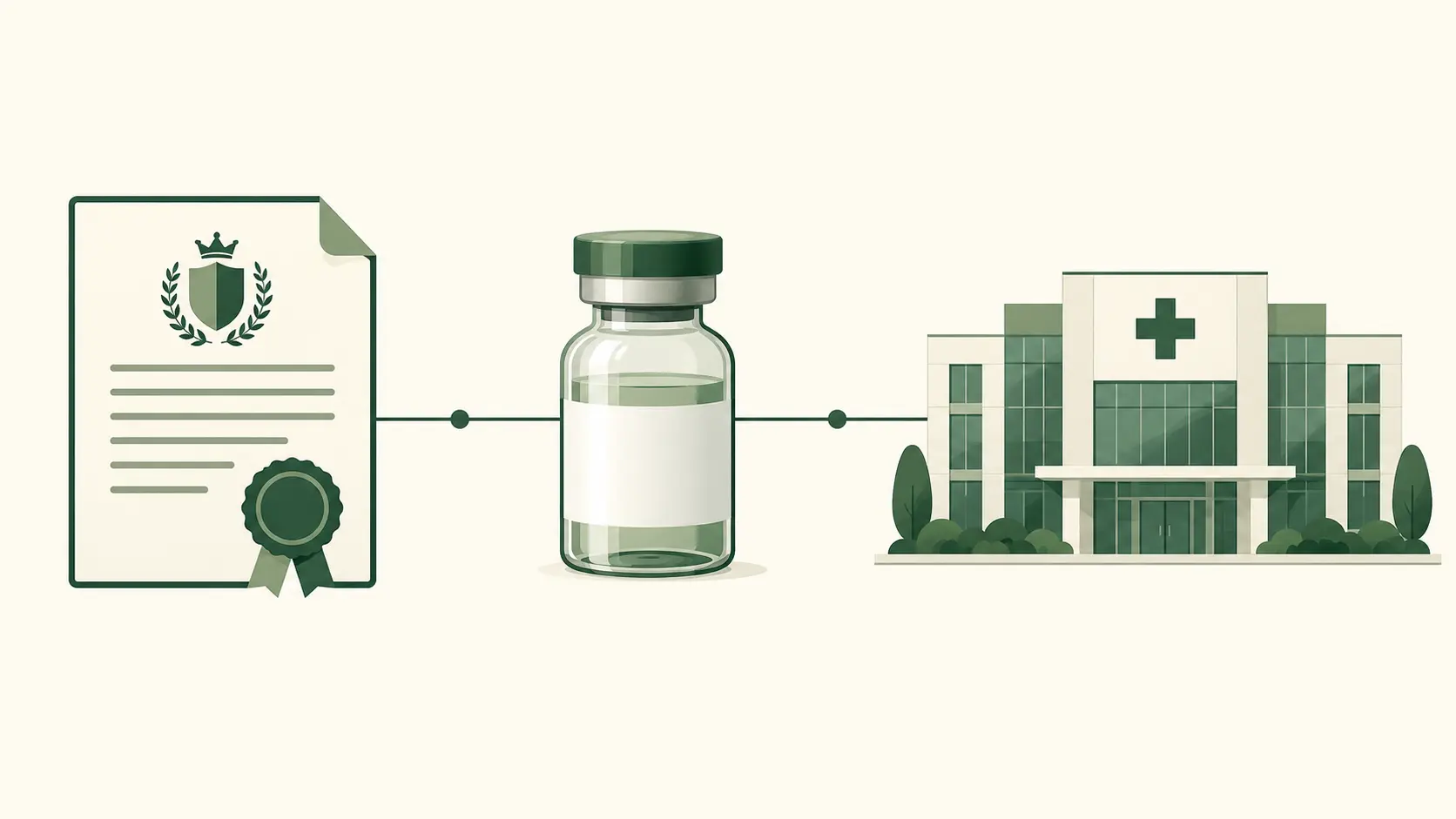
The most useful way to understand the Royal Decree is to follow the route a patient takes. There are five steps, and at none of them does a high-street pharmacy or a shop appear. Tap each step to see the detail:
Everything starts in a specialist consultation within a hospital: neurology, oncology or a pain unit, depending on the case. A GP cannot prescribe these formulas, and neither can a private practice outside a hospital. The specialist assesses whether the patient fits one of the clinical situations provided for and whether conventional treatments have already been exhausted.
The prescription has to be justified and documented. The patient asking for it is not enough: the doctor records the clinical reasons, the previous treatments that have failed and the dose, always within the limits the AEMPS monograph sets for each preparation.
The raw material is a standardised preparation entered in the AEMPS public register. Only extracts with a defined THC and/or CBD composition, made by licensed companies, may be used. As of October 2026 there is a single authorised supplier in Spain, with two preparations: one CBD-dominant and one THC-dominant.
The hospital pharmacy service compounds the magistral formula following Good Compounding Practice and the National Formulary monograph. That is why the result is identical in any Spanish hospital: same composition, same route of administration (oral) and the same quality and traceability controls.
Dispensing is also hospital-based, with shared follow-up. The prescribing doctor and the pharmacist periodically assess whether the treatment is working and whether adverse effects appear, and decide whether to continue. For patients who are dependent, vulnerable or live far away, the regional governments may set up non-presential dispensing arrangements.
Note the detail that most surprises people coming from other countries: in Spain, medical cannabis never leaves the hospital at any point in the process, except in the bag of the patient it has just been dispensed to.
Which clinical situations it covers
The Royal Decree does not set a closed list of diseases, and that is deliberate: the idea is that the AEMPS can add indications as the evidence grows. But it does name the clinical situations the system starts with, always on condition that the usual treatments have not been sufficient:
| Clinical situation | What the preparation aims to do | Specialty usually involved |
|---|---|---|
| Spasticity associated with multiple sclerosis | Reduce stiffness and muscle spasms when standard muscle relaxants are not enough | Neurology |
| Some forms of severe refractory epilepsy | Lower seizure frequency in patients (often children) who do not respond to anti-epileptic drugs | Neurology, paediatric neurology |
| Chemotherapy-induced nausea and vomiting | Control symptoms when conventional anti-emetics fail | Oncology |
| Refractory chronic pain | Relieve persistent pain that does not respond to the usual analgesic ladder | Pain units, anaesthesiology |
Two important caveats. First: being diagnosed with one of these conditions gives no automatic right to the treatment; the decision always rests with the specialist, case by case. Second: widely searched issues such as anxiety, insomnia or mild pain are not among the indications, however often they circulate online as “medical cannabis uses”. For the real difference between the two main cannabinoids, see our practical CBD vs THC guide.
What you will not find: expectation versus reality
This is probably the most useful part of the article, because most of the questions we get come from comparing Spain with Canada, with some US states, or with Germany. It does not work that way here:
| What many people expect | What the Royal Decree says |
|---|---|
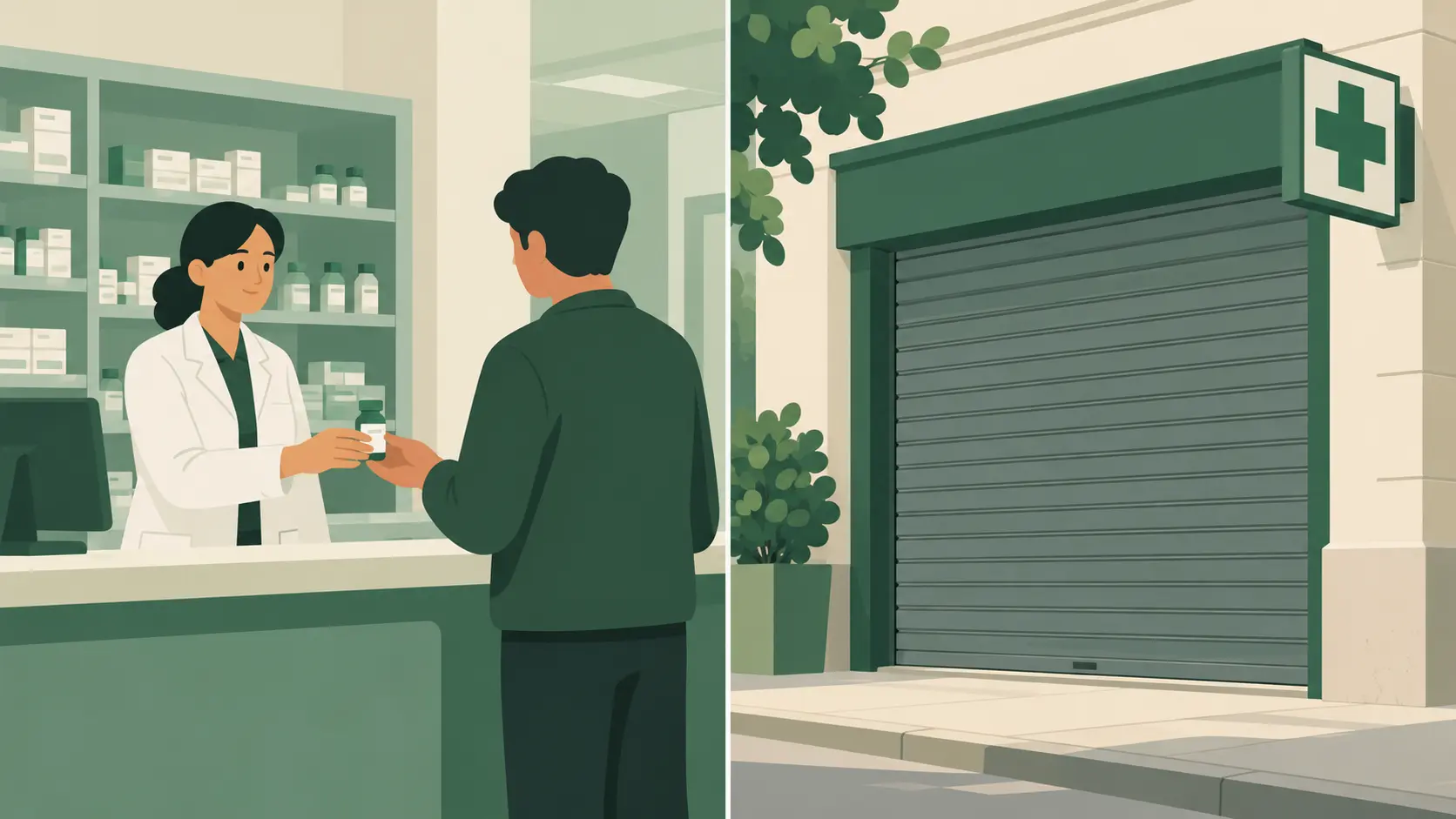
| Buying it at the pharmacy on the corner | No. Compounding and dispensing are exclusive to hospital pharmacy services. The rule leaves open a possible future role for community pharmacies in exceptional cases, but today it does not exist. |
| Cannabis flower to smoke or vaporise | No. Only standardised preparations (extracts) in magistral formulas for oral administration, with doses set by the doctor within the limits of the monograph. Smoking is not a route of administration for a medicine. |
| A prescription from a GP or family doctor | No. Only medical specialists working within a hospital. |
| Using a prescription or patient card from home | No. A prescription issued in Germany, Canada, the UK or a US state cannot be dispensed in Spain, and the Spanish circuit has no patient card at all. Travelling with your own supply is a separate problem, which we cover in is medical cannabis legal in Seville for foreign patients? |
| Authorised therapeutic home growing | No. The Royal Decree does not touch home cultivation, which remains in the same legal situation as always. |
| Being allowed to drive while on treatment | No exception. Traffic law penalises the presence of THC in saliva, prescription or not. It is one of the points the Royal Decree left unresolved, and we cover it in how long THC stays in your system. |
| Buying CBD in a shop “because it is medical now” | Two different worlds. Shop-bought CBD is not a medicine, and in Spain it is not authorised for ingestion. We explain it in CBD in Seville: benefits, uses and legislation. |
It is a hospital medicine, not an open door to cannabis
Royal Decree 903/2025 turns certain cannabis extracts into one more medicine within the healthcare system, with its controls, its traceability and its pharmacovigilance. It changes nothing about the legal status of cannabis outside the hospital: not for adult use, not for growing, not for possession in the street.
From the Gazette to the hospital: rollout timeline
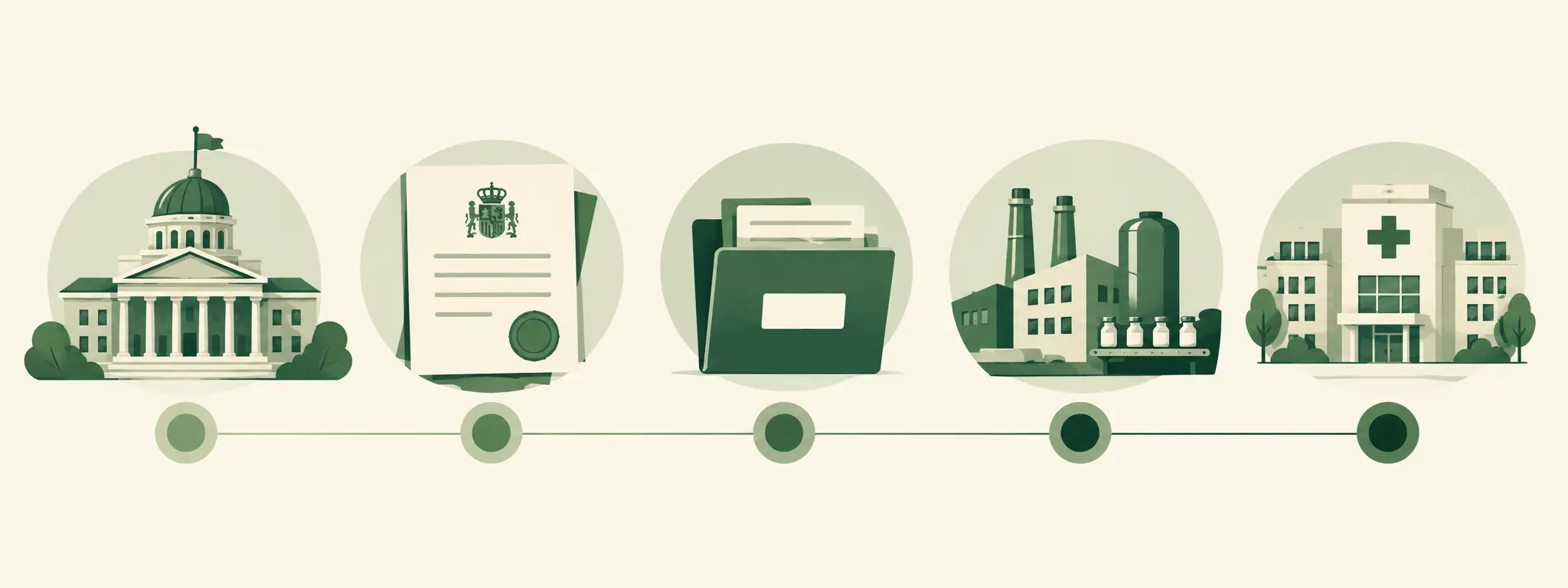
An approved rule is not the same as an available treatment. Between the Official State Gazette and the first patient, a full year of registers, monographs and authorisations has gone by:
The Council of Ministers approves Royal Decree 903/2025, at the proposal of the Ministry of Health and at the request of the Congress Health Committee, after several years of subcommittees and drafts.
Publication in the Official State Gazette (BOE) and entry into force the following day. The AEMPS is given three months to publish the National Formulary monographs that specify preparations, doses and conditions of use.
The monographs are published and the AEMPS opens the register of standardised preparations on 19 January. From here, companies with a cultivation licence can apply to have their extracts registered.
The first (and so far only) supplier is authorised: a company based in Alicante, with two registered preparations, one CBD-dominant and one THC-dominant. Only two companies had applied at all.
The AEMPS completes the process that allows hospital dispensing and the first orders begin to reach hospital pharmacy services. Medical societies expect supply to patients to start gradually between late October and November.
What remains unresolved
The system having started does not mean it is complete. These are the open questions in October 2026, worth knowing before building up expectations:
An uneven rollout
The rule is national, but each hospital decides when to place its first order and each regional government whether to enable non-presential dispensing. In September the Ministry admitted it had no data on which regions had activated it. There will be territories and hospitals months apart.
A single supplier
With one authorised company and two preparations, the initial supply is narrow. Any production or logistics hiccup shows up immediately. More suppliers are expected to join, but the registration process has proved slow.
Doctors still in training
Prescribing cannabis is new to almost every specialist. The Spanish Pain Society and the AEMPS have launched an expert course for around 60 doctors and pharmacists. Until that training spreads, many specialists will be cautious about prescribing.
Driving and work, in no man’s land
The Royal Decree does not amend traffic or employment law. A patient on a prescribed treatment can test positive at a roadside saliva check and face the same penalty as any other driver. It is a gap that was flagged during the drafting and is still there.
On top of this, the Royal Decree provides for continuous updating: the AEMPS can expand the indications and revise the monographs as data from the first patients come in. Changes during 2027 are reasonable to expect.
And in Seville? What this means for a member
For anyone who is a member of a club in Seville, or thinking about it, regulated medical cannabis and the association model are two realities best kept apart:
- A social club is not a healthcare resource. A cannabis social club in Seville is an association of adult consumers who share a crop in a private space. It does not prescribe, does not dispense medicines and is not part of the Royal Decree circuit. If you have a condition and think cannabis might help, the route is a hospital specialist, not an association.
- If you are a patient and already consume, tell your doctor. It is the most useful advice we can give. The specialist needs to know in order to assess interactions with other drugs and to decide whether switching to a controlled formula with a known dose makes sense.
- If you are visiting with a prescription from home, the Royal Decree does not change your situation: a foreign prescription cannot be dispensed here, and carrying cannabis remains subject to fines. We explain it in our guide for foreign medical cannabis patients.
- Hospitals in Andalusia follow the same staggered calendar as the rest of Spain. There is no public list of centres already dispensing; the way to find out is to ask at your specialist’s consultation or at the pharmacy service of your referral hospital.
- The legal framework for adult use has not moved. Everything we describe in is it legal to smoke marijuana in Seville? still applies: tolerated in private, fined in public, with sale prohibited.
A private space where you can ask questions and understand how the association model works
FIND OUT HOW A CSC WORKSWe are at C. Bartolomé de Medina 24 (41004 Seville), an 8-minute walk from Prado de San Sebastián.
Frequently asked questions about medical cannabis in Spain
The questions that come up most often, answered without the runaround.
Can I use my medical cannabis prescription from another country in Spain?
No. The Spanish circuit only recognises prescriptions issued by hospital specialists within Spain, and the formulas are compounded and dispensed in Spanish hospital pharmacies. A prescription or patient card from Germany, Canada, the UK or a US state has no effect here, and bringing your own supply into the country means travelling with a controlled substance.
Can I buy medical cannabis in a pharmacy in Spain?
No. Royal Decree 903/2025 reserves compounding and dispensing for hospital pharmacy services. Community pharmacies do not stock these preparations. The rule envisages that community pharmacies might take part in the future, in exceptional cases, but that route has not been developed.
Which doctors can prescribe medical cannabis in Spain?
Only medical specialists working within hospital care, with documented clinical justification and when conventional treatments have not been sufficient. A family doctor cannot prescribe it, nor can a private practice outside a hospital.
Which conditions is medical cannabis approved for in Spain?
The system starts with four clinical situations: spasticity associated with multiple sclerosis, some forms of severe refractory epilepsy, chemotherapy-induced nausea and vomiting, and refractory chronic pain. The list is not closed and the AEMPS can expand it as evidence builds.
Can medical cannabis be smoked or vaporised in Spain?
No. The magistral formulas provided for are standardised preparations for oral administration, with doses set by the doctor within the limits of the AEMPS monograph. Cannabis flower for smoking or vaporising is outside the Royal Decree.
Can I drive if I have been prescribed medical cannabis in Spain?
Traffic law makes no exception. Roadside saliva tests penalise the presence of THC, prescription or not. It is one of the points the Royal Decree left unresolved, so a patient on treatment carries the same risk as any other driver and should plan accordingly.
The information in this article is based on Royal Decree 903/2025 and on public information from the AEMPS and the Ministry of Health available on the date of publication; the rollout is under way and details may change. This content is informative and does not constitute medical or legal advice: any decision about treatment belongs to a healthcare professional. Green City is a private, non-profit association for adults who are already consumers and is not part of the healthcare circuit. We do not promote cannabis use: we encourage those who already consume to do so responsibly, consciously and within the law.