

Keeping cannabis from spoiling at home comes down to four variables: light, humidity, temperature and air. The reference range for relative humidity sits between 55 % and 62 %, temperature below 25 ºC and preferably between 15 and 21 ºC, the container airtight and opaque, and the spot dark and stable. Of the four factors, light is the most destructive: it is what turns THC into CBN and what strips out the terpenes. And in Seville there is an added problem, because the climate here pushes towards both ends of the range.
Important note: Green City does not promote cannabis use. We are a private non-profit association of adults who are already consumers. This article is about storage, not acquisition: its purpose is informative and preventive, because badly stored material can develop mould, and that is a genuine health risk. Nothing you read here is an invitation to stockpile or to consume.
There is a scene that keeps repeating: someone opens a jar that has been in a drawer for months, smells it, and what comes out bears no resemblance to what they remember. No aroma, no texture, no effect. What happened was not time. It was how it sat during that time.
Storage usually gets treated as a minor detail next to flashier questions, and it is the other way round: it is the factor you have most real control over, and the one that explains most disappointments. The good news is that nothing expensive is required. Two or three sound decisions are required, plus avoiding a handful of very common mistakes.
What you will find here
- The four enemies
- Humidity: the range almost nobody respects
- Why light is the most destructive factor
- What happens to THC over time
- The container: what works and what does not
- Where to keep it and where not to
- Mistakes that do more damage than time
- When it has to be thrown away
- Seville: the climate here works against you
- Frequently asked questions
The four enemies
Everything that degrades dried cannabis fits into four factors. They act at once and reinforce one another, so getting one right counts for little if another is wrong.
Light
Ultraviolet radiation breaks cannabinoids down. It is the single factor that does most damage.
Humidity
Too much brings mould. Too little evaporates the terpenes and makes trichomes brittle.
Temperature
Heat speeds up every degradation reaction and makes aromas more volatile.
Air
Oxygen oxidises THC. Every time you open the jar, the process moves on a little.
Humidity: the range almost nobody respects
Of the four, humidity has the most visible consequences and gets measured the least. The reference range for storage sits between 55 % and 62 % relative humidity inside the container. Outside that, in either direction, the problems start.
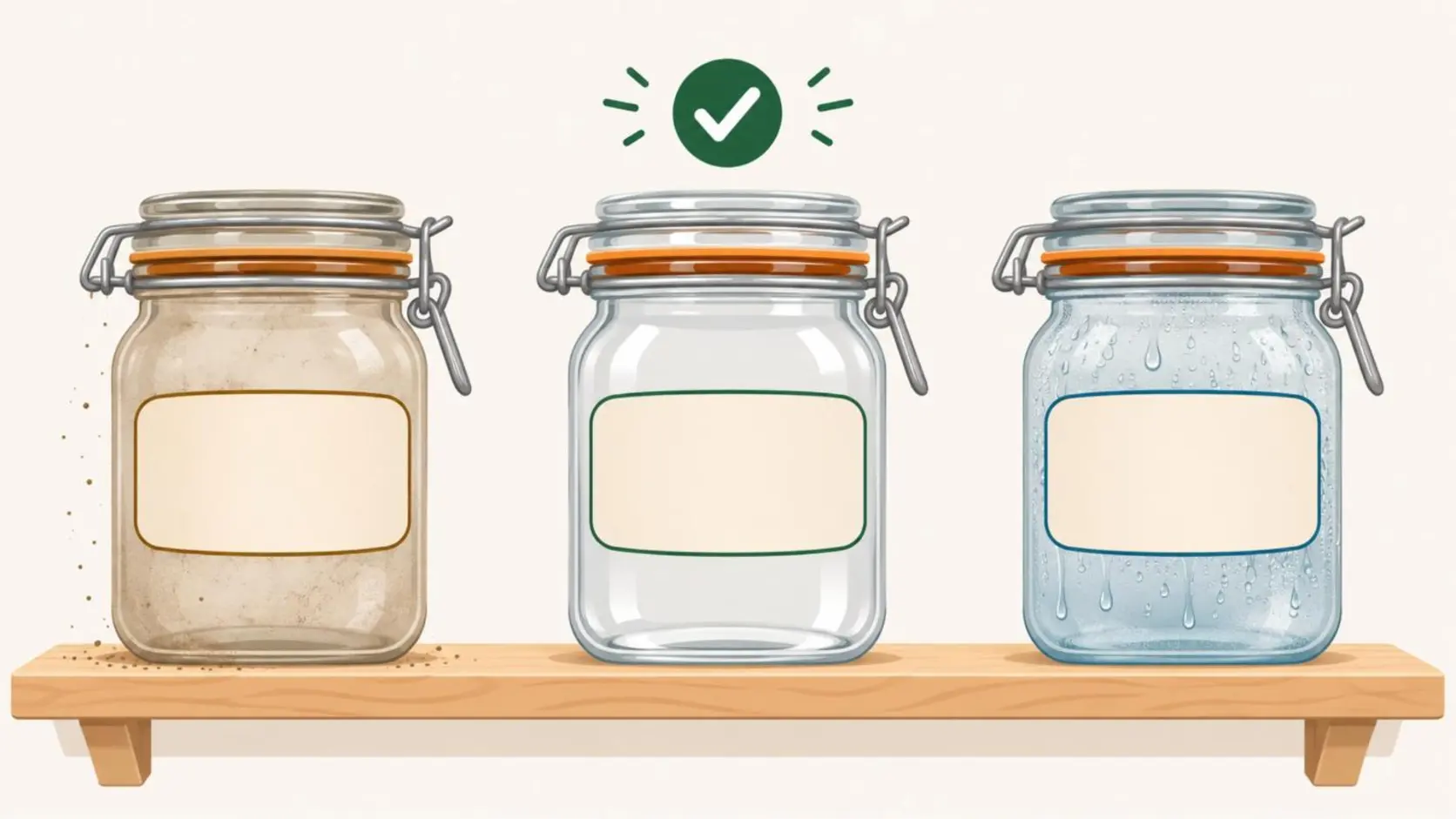
Move the control and see what happens in each band
Relative humidity inside the jar. The marked zone is the reference range.
Reference rangeTerpenes hold, the texture is right and mould risk is low. This is the band to aim for.
Below 45 % the material dries out, trichomes turn brittle and crumble at the slightest touch, and the flavour reduces to nothing because terpenes, being volatile compounds, have gone into the air. Above 65 % the problem changes nature: it is no longer a loss of quality, it is a health risk, because that humidity is what fungi need. Botrytis cinerea is the most cited, though not the only one.
Humidity-regulating packs calibrated to 62 % are the sector standard and solve the problem without measuring anything: they absorb humidity when there is too much and release it when there is too little. What does not work, and still gets repeated, is putting a slice of fruit, bread or lettuce in the jar. That does not regulate: it adds uncontrolled humidity plus organic material, which is exactly the combination that leads to mould.
Why light is the most destructive factor
This point has old and fairly solid backing. The reference study, published by Fairbairn, Liebmann and Rowan in the Journal of Pharmacy and Pharmacology in 1976, followed samples kept under different conditions for two years and concluded that light exposure was the single most destructive factor for cannabinoids, above even temperature. A stability study by the United Nations Office on Drugs and Crime, from 1999, reached the same conclusion and measured a loss of around 16 % of THC over one year at room temperature.
These are orders of magnitude drawn from the stability literature, not a laboratory measurement of your jar.
The practical translation is short: a clear glass jar on a shelf in plain view is the worst possible decision, however good it looks. If the container is transparent, it has to live inside a closed cupboard. Amber or violet glass filters part of the ultraviolet and helps, but it is no substitute for darkness.
What happens to THC over time
THC does not simply vanish: it transforms. The main degradation pathway turns it into CBN, cannabinol, a cannabinoid with a considerably more sedative effect and much less psychoactive potency. That is where the recognisable sensation of old material that «does nothing except make you sleepy» comes from. It is not a subjective impression, it is a chemical conversion. If you are curious about how cannabinoids fit into the body, we explain it in the endocannabinoid system explained simply.
Degradation is not linear: it runs faster during the first year and then slows. And it hits terpenes before cannabinoids, because they are more volatile compounds. That is why aroma is the first thing to go, and aroma is the best domestic indicator you have: when material stops smelling the way it used to, it has already started changing inside. If you are curious why each variety smells different, that is in sativa, indica or hybrid and in the most popular strains in Seville.
The container: what works and what does not
| Container | Verdict | Why |
|---|---|---|
| Airtight glass jar | The best | Gives off no flavours, seals properly and keeps humidity stable. Kept in darkness, it is the reference option. |
| Amber or violet glass | Very good | Everything above plus it filters part of the ultraviolet. Still needs a dark spot. |
| Opaque stainless steel tin | Good option | Blocks light completely. The lid should have a gasket. |
| Thin plastic or zip bag | Poor | Not genuinely airtight, generates static that pulls trichomes off, and gets crushed by everything. |
| Soft plastic container | Poor | Can impart smell and taste, and many do not seal properly. |
| Grinder or rolling box | Same-day only | Neither airtight nor opaque. Fine for immediate use, not for storage. |
| Freezer | With reservations | Slows degradation, but cold makes trichomes brittle and every thaw cycle creates condensation. Only makes sense vacuum-sealed and left untouched. |
Where to keep it and where not to
The right container in the wrong place counts for nothing. What you want is somewhere dark, cool and stable in temperature, which rules out almost the whole kitchen.
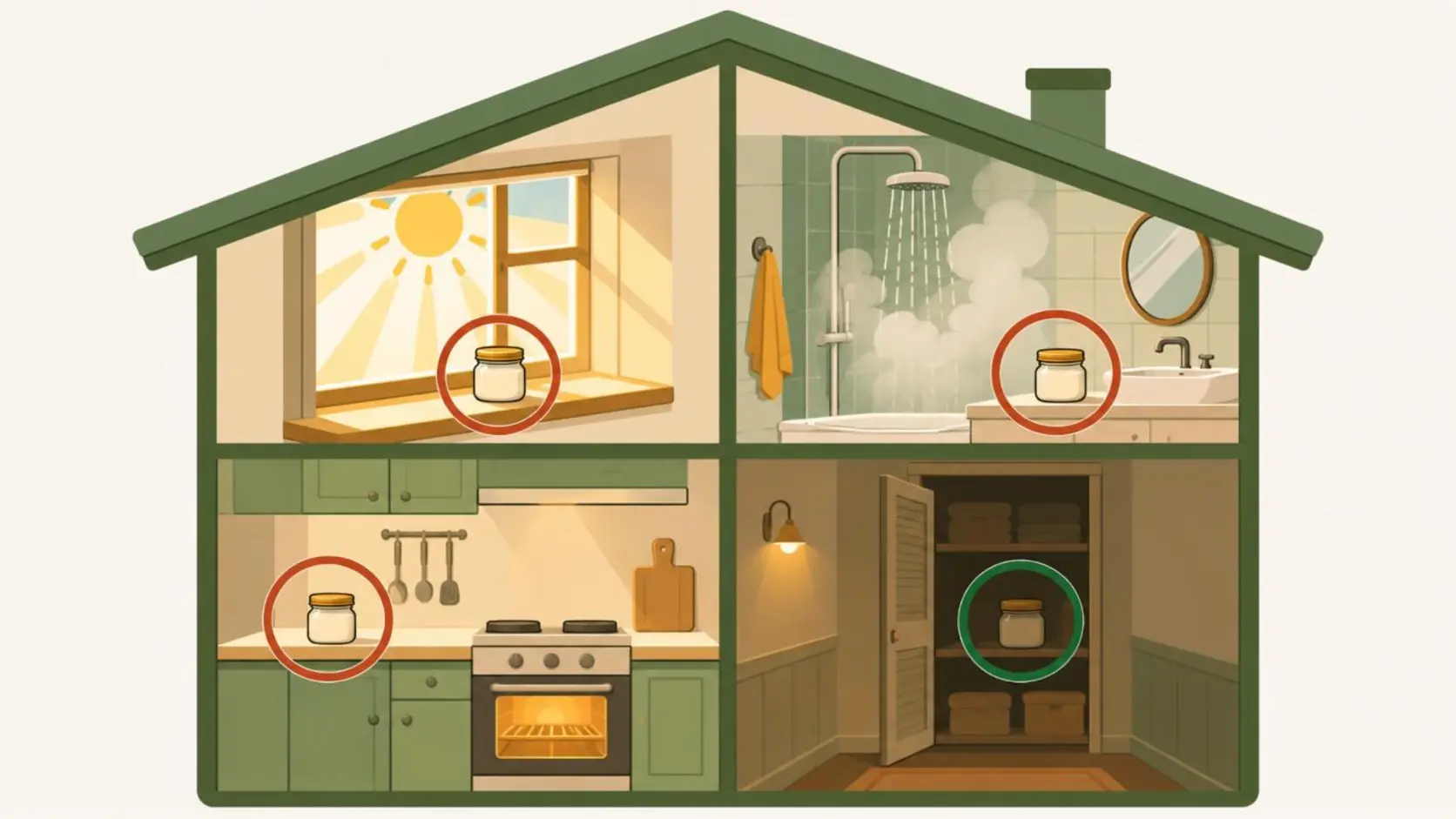
Places that work
- An interior cupboard, away from windows and radiators
- A drawer in a room that gets no direct sun
- A unit in the hallway or an interior part of the home
- Any enclosed space where the temperature barely moves
Places that ruin it
- The windowsill or anywhere with direct light
- On top of or beside the fridge, which radiates heat at the back
- The bathroom, because of sharp humidity swings
- A kitchen cupboard near the oven or hob
- The car, which turns into an oven in summer
- A storage room or roof terrace with no insulation
Mistakes that do more damage than time
- Opening the jar constantly
Every opening renews the oxygen and releases humidity. If you are keeping a quantity, it makes more sense to have a small jar for everyday use and leave the main one closed.
- Handling it
Trichomes, where much of what matters is concentrated, come off with friction. The less it is touched, the better it keeps.
- Grinding it in advance
Grinding multiplies the surface exposed to air and speeds up aroma loss. Grind at the moment, not before.
- Mixing new with old
If the older material carries too much humidity, it passes it on. And if it has any fungus, it spreads through the whole jar.
- Filling the jar to the brim or leaving it half empty
Too tight crushes the material; too much air inside speeds up oxidation. Match the jar size to what you are keeping.
- Using silica gel from a random packet
Those sachets are designed to dry, not to regulate. They take the material below 40 % humidity and strip the aroma with it.
When it has to be thrown away
This part allows no nuance, because here it is no longer about quality but about health. Material with fungi cannot be recovered, cleaned, or fixed by drying it out.
A smell of damp, of cellar, of ammonia or of enclosed air, which is different from its own aroma even when that has faded. Whitish or greyish patches looking like dust or cobweb, not to be confused with trichomes, which are crystalline and catch the light. A damp or soft feel when it should be dry. And any compacted appearance with dull-coloured areas inside. When in doubt, throw it out. Inhaling fungal spores is a real respiratory risk, especially for anyone with asthma, allergies or a weakened immune system.
Seville: the climate here works against you
What makes this a particularly Sevillian topic is that the climate here does not push towards the good range: it pushes towards both extremes, at different times of year.
In summer, with forty degrees outside and an interior that does not drop easily below thirty, the two bad conditions arrive together: high temperature and dry air. A jar in a room without air conditioning can sit well above 25 ºC for weeks, and low ambient humidity dries out the contents every time it is opened. That is the critical period, and it fits with what we cover in cannabis and Seville heat.
In the rainy months the risk inverts. A Seville ground-floor flat with damp in the walls, or a cupboard against an exterior wall, can go above 70 % ambient humidity without anyone noticing. There the problem is no longer drying out: it is mould.
The practical conclusion for Seville is that a humidity-regulating pack is not a luxury, it is what compensates for a climate that moves a lot. And that where in the home matters more here than in stable climates: an interior room, away from exterior walls and heat sources, makes a real difference.
Keeping it at home for personal use falls outside the scope of penalties, because private consumption and possession for personal use are not crimes. What changes things is going out into the street: there Organic Law 4/2015 applies and possession in a public place is an administrative offence, with the amounts we explain in the fine for carrying marijuana. That is why whatever someone keeps at home should be consistent with personal use: accumulation is precisely what can change the legal reading, as you can see in the Spanish cannabis social club model. And if you are going to move around by train, plane or car, that is in travelling with cannabis in Spain.
Frequently asked questions about storage
How long does cannabis keep well?
Under correct conditions (darkness, airtight container, 15 to 21 ºC and humidity in the reference range) it holds much of its character for six months to a year without striking changes. After that the loss is gradual, above all in aroma. Under bad conditions, a few weeks of direct sun do more damage than a year stored properly.
Can you keep cannabis in the fridge?
It is not a good idea. The fridge runs at high humidity and, every time you take the jar out, the condensation forming as it moves from cold to room temperature leaves water inside. That uncontrolled humidity favours mould. A cool, dark cupboard works better.
Does cannabis expire?
It does not expire in the food sense of the term. What happens is that THC gradually converts into CBN, terpenes evaporate, and the whole thing loses aroma and potency. What does have health consequences is mould, and that depends on storage conditions rather than elapsed time.
How do I tell mould from trichomes?
Trichomes are crystalline, catch the light and spread evenly across the surface. Mould is matt, whitish or greyish, looks like dust or cobweb, and tends to concentrate in patches or inside. If there is also a smell of damp, enclosed air or ammonia, discard it.
Is vacuum sealing any good?
For long-term storage left untouched, yes: it removes almost all the oxygen and slows oxidation. It has two drawbacks. The vacuum crushes the material and breaks trichomes, and every opening means resealing. For everyday use an airtight jar is more practical.
Can you rehydrate cannabis that has dried out too much?
Texture can be recovered with a humidity-regulating pack, slowly and without rushing. What does not come back are the terpenes, already evaporated, so aroma and flavour do not recover. Never rehydrate with water, fruit or organic material: the usual result is mould within days.
Does storage affect how long THC stays in the body?
Not directly. What degradation changes is the proportion of THC left in the material, not the way your body processes it. Detection windows by test type are in how long THC stays in your system, and if you drive it is worth reading cannabis and driving: the DGT saliva test.
Guidance from people who know the material closely
Green City Sevilla is a private association of adults who are already consumers. Part of what we do is accompany and advise members on questions like this one. If you are already a consumer, here is how access works.
HOW TO BECOME A MEMBER More than 10 years in Seville · C. Bartolomé de Medina 24, B1