

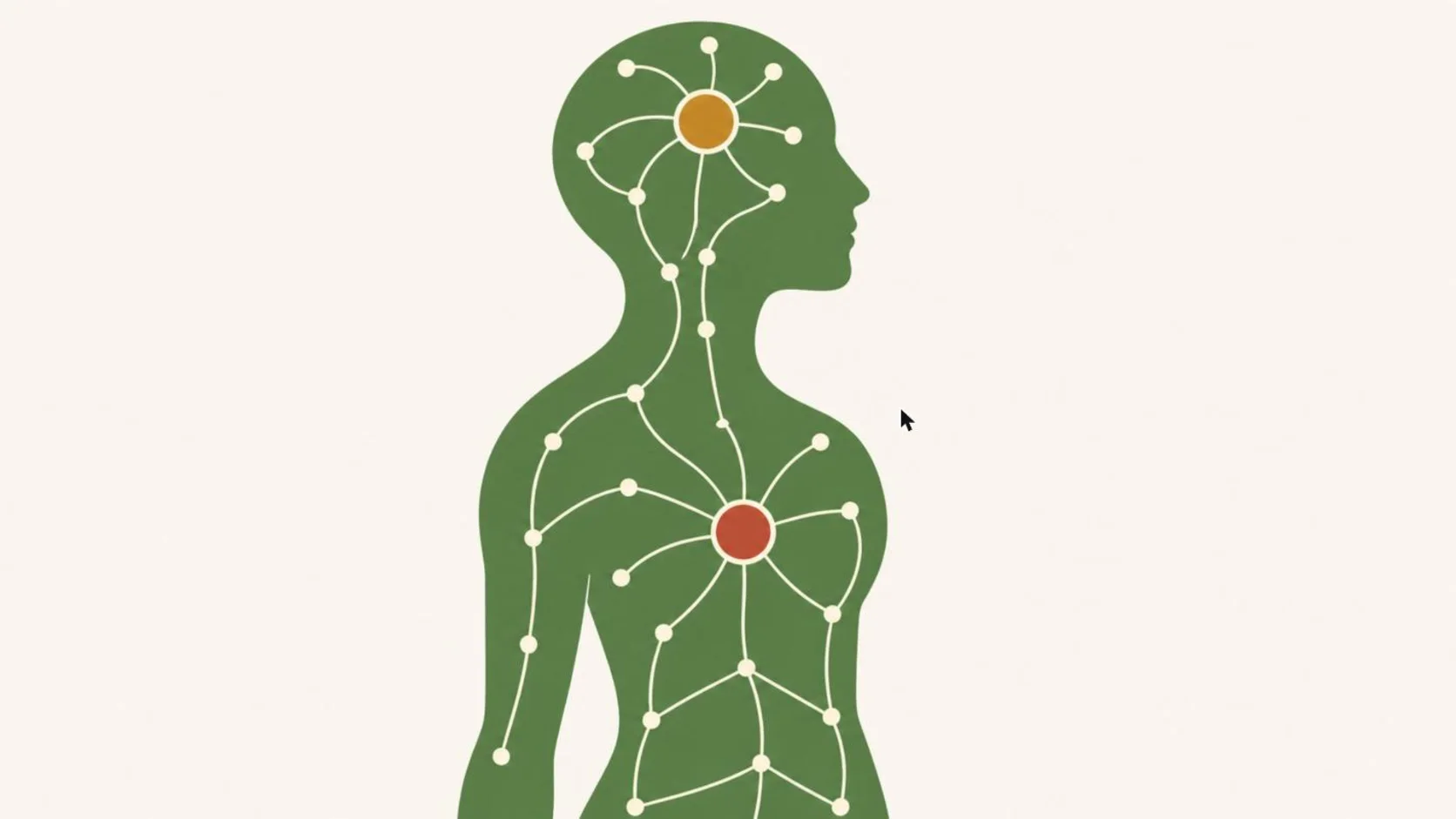
The endocannabinoid system is a network of regulators your body builds on its own, and it keeps things as different as appetite, pain, sleep, mood and immune response inside a workable range. It has three parts: receptors (CB1 and CB2), molecules your body makes to activate them (anandamide and 2-AG) and enzymes that clear those molecules away almost immediately. THC produces effects because its shape resembles those molecules closely enough to fit the same receptor, with one important difference: yours switch off in seconds, and THC stays for hours.
There is a question that comes up again and again in the club’s afternoon conversations, and it is usually asked by someone who has been consuming for years: «but why exactly is this happening to me?». Why laughter one day and silence the next, why the appetite some days and none on others, why your friend gets sleepy and you get the opposite. The answer is not in the plant. It is in a system your body had running long before you tried anything, and one that was not even found by looking for it.
This article explains it without jargon and without promises. You will not read here that cannabis cures anything. You will understand the mechanism, which is a good deal more interesting.
What you will find here
- What the endocannabinoid system is and what it does
- The three parts of the system
- CB1 and CB2: where they are and what they do
- The signal that travels backwards
- Where THC fits and where CBD fits
- Why the same strain affects two people differently
- How all of this was discovered (1964-1995)
- What this changes for a member in Seville
- Frequently asked questions
What the endocannabinoid system is and what it does
The prefix «endo» means «from within». The endocannabinoid system (you will see it shortened to ECS) is the set of parts your body uses to produce and receive its own cannabinoids. It is working right now as you read, with nothing consumed.
Its job carries a rather thankless technical name: homeostasis. In plain terms, keeping the body’s variables inside a reasonable margin. The comparison that works best is not a switch but a dimmer. When a neuron is firing too much, the system does not shut it off: it turns the intensity down just enough to bring it back into range. When the signal falls short, it turns it up. And it does this locally, at the exact point where it is needed, rather than across the whole body at once.
The endocannabinoid system works like a dimmer that corrects deviations, not like an on/off button.
That is why summarising «what it is for» is so hard. It does not govern one specific function the way the digestive system does. It shows up in the background of many of them, modulating. Which is also why its discovery opened so many research lines at once, and why it pays to be sceptical of any website presenting it as the master key to health.
The three parts of the system
For the dimmer to work you need three things: something to receive the instruction, something to give it, and something to erase it once it is no longer needed.
Receptors
CB1 and CB2. These are the locks. They sit across the nervous system, the immune system and several organs.
Endocannabinoids
Anandamide and 2-AG. The keys your body makes. They are not stored: they are produced at the moment they are needed.
Enzymes
FAAH and MAGL. They take the keys apart as soon as the job is done. This is why your body’s own effect lasts seconds.
That third part is the one almost nobody mentions, and it is the one that explains the underlying difference between what your body does and what a substance arriving from outside does. Anandamide is made, acts and disappears in a single gesture. THC comes in and the enzymes do not recognise it the same way, so it stays bound to the receptor for far longer. Same mechanism; different duration. If you are curious about how long it stays and how long it takes to leave the body, that is covered in how long THC stays in your system.
Anandamide takes its name from ananda, «bliss» in Sanskrit. The name was proposed by the team that identified it in 1992. It is a nice detail, though the relevant fact is a different one: anandamide is a partial agonist, binding to the receptor without fully activating it. 2-AG, the most abundant endocannabinoid in the body, is a full agonist. The system has gradations of intensity even among its own molecules.
CB1 and CB2: where they are and what they do
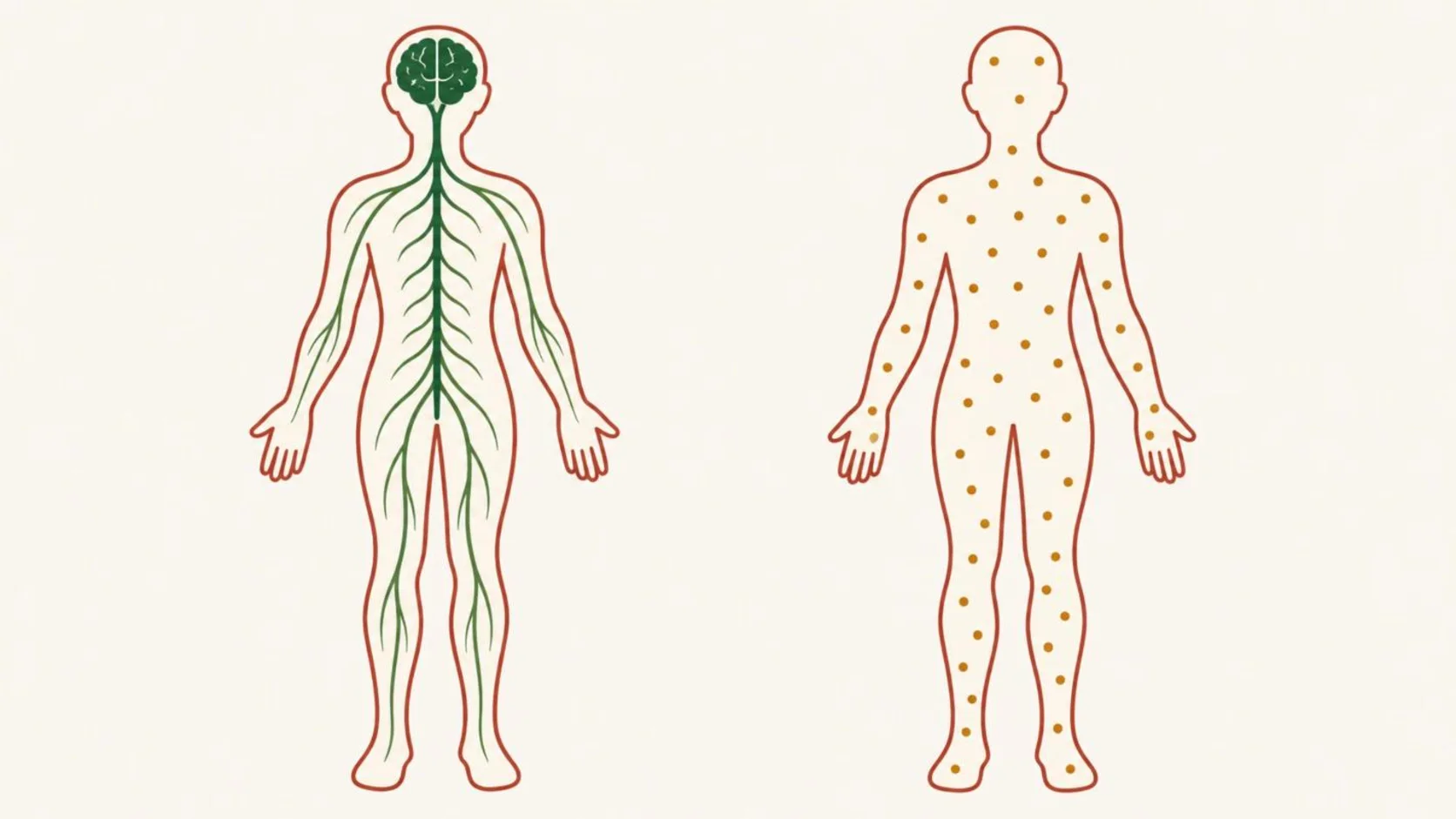
Both receptors belong to the same family, but they sit in different places and handle different things. This table is the only part of this article worth memorising.
| CB1 receptor | CB2 receptor | |
|---|---|---|
| Where it is abundant | Central nervous system. One of the most abundant receptors in the brain. | Immune and blood cells. Also liver and vascular tissue, and in the brain at much lower levels. |
| What it handles | Modulating communication between neurons: memory, appetite, pain, coordination, time perception. | Modulating immune response and inflammatory processes. |
| Relationship with THC | The receptor behind the psychoactive effects. Everything you notice starts here. | Barely involved in the subjective effect. This is the pathway that concentrates clinical research interest. |
| Discovered in | 1988, cloned in 1990 | 1993 |
The distribution of CB1 explains some very concrete things. There is high density in the hippocampus, involved in forming new memories, hence that momentary «what was I saying». There is a fair amount in the cerebellum and basal ganglia, which coordinate movement. And there is very little in the brainstem, the area regulating breathing and heartbeat. That specific scarcity is the physiological reason why a cannabis overdose bears no resemblance to an overdose of other substances, however unpleasant the episode. What actually happens when someone goes too far is covered in how to avoid greening out.
The signal that travels backwards
Here is the part that usually surprises people. In the rest of the nervous system the message travels one way: the sending neuron releases a neurotransmitter and the receiving neuron picks it up. The endocannabinoid system works the other way round. It is called retrograde signalling.
When the receiving neuron is getting too much signal, it manufactures endocannabinoids on the spot and sends them backwards, to the neuron doing the sending. There they activate CB1 receptors, and the message they carry is essentially «turn it down». The neuron receiving asks the neuron sending to modulate. A feedback loop the body uses to keep any circuit from running away with itself.
Retrograde signalling: the message travels upstream. The receiving neuron asks the sending one to modulate.
The fact that THC activates those same CB1 receptors has a counterintuitive consequence: it does not add a new signal, it interferes with the regulating system itself. As if the dimmer got stuck in one position for a couple of hours, regardless of what is happening in that circuit. Hence effects that are so sensitive to context and to each person’s starting state.
Where THC fits and where CBD fits
The lock-and-key image is useful if handled carefully. The three molecules everyone talks about relate to the CB1 receptor in different ways.
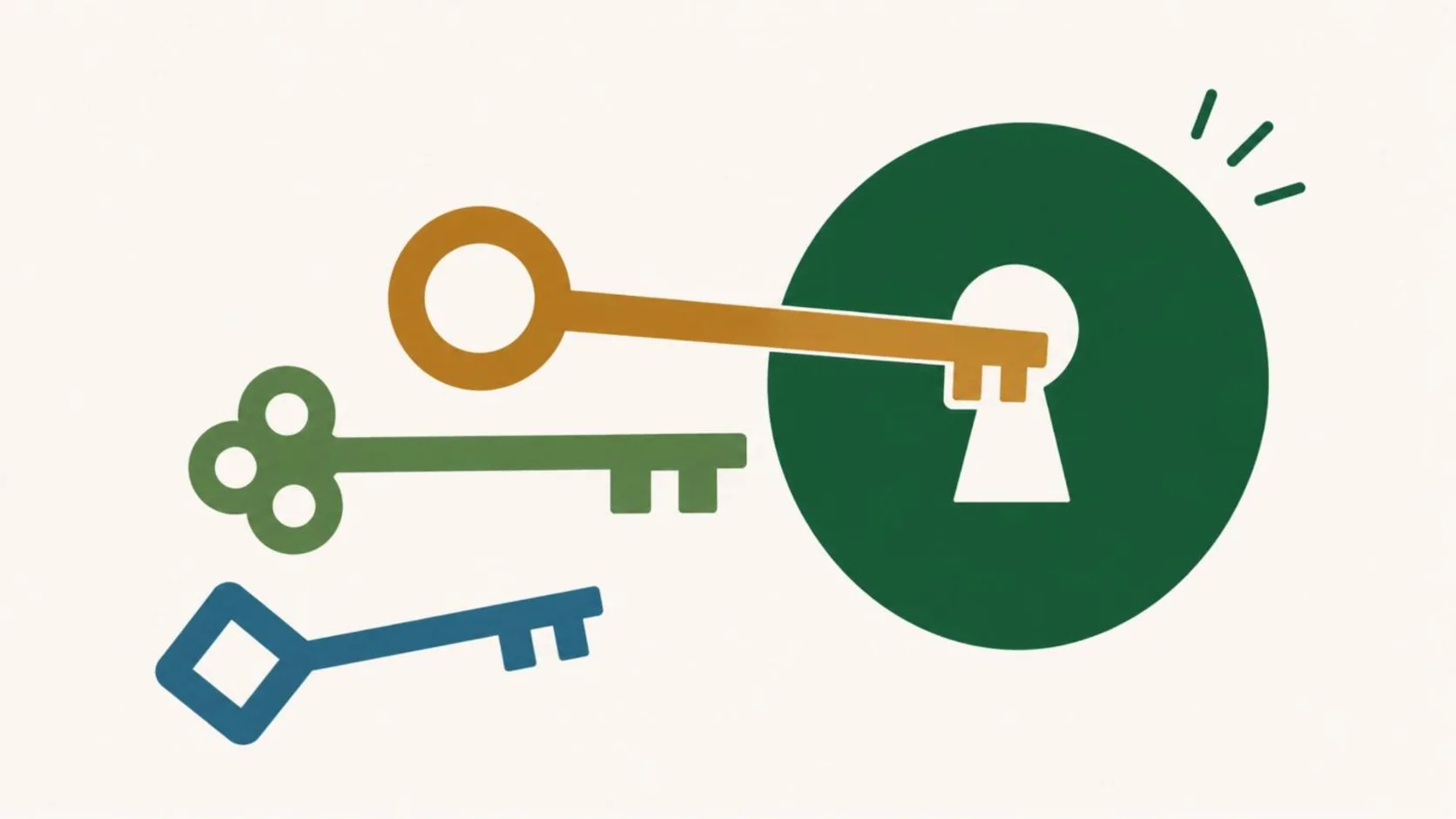
Anandamide and 2-AG
Your own keys. They fit CB1 and CB2 precisely and are withdrawn within seconds, as soon as the enzymes take them apart.
Exact fit · minimal durationTHC
A similar key that opens the same lock. The body does not clear it with the same efficiency, so the signal stretches out over hours.
Fits · long durationCBD
Does not open that lock. It acts elsewhere and changes how the receptor responds to what does open it. No psychoactive effect.
No CB1 fit · acts differentlyThat difference is the whole explanation of why CBD does not get you high. It is not that it is «milder»: its point of action is somewhere else. The two molecules compared in detail, with the practical side, are in CBD vs THC: a practical guide, and any loose term you run into along the way is in the cannabis glossary.
Why the same strain affects two people differently
This is the question that brings most people here. Two people, the same material, two experiences that bear no resemblance. The answer has to do with the receptor being the same while the system it acts on differs from body to body.
Those last two are often dismissed as subjective, and they are not. The route of intake changes the biochemistry: the digestive route produces a different metabolite, which is why the effect is perceived differently, as explained in the article on edibles. And context matters because the endocannabinoid system is involved in regulating anxiety: the same stimulus in a calm place and in an uncomfortable one is not processed the same way.
What this dismantles is the idea that some strain exists that suits everybody. The old classification into sativa, indica and hybrid gives you a starting orientation, not a forecast, and we qualify that in sativa, indica or hybrid: what to choose.
How all of this was discovered (1964-1995)
One detail explains why the endocannabinoid system is so little known outside science: it was discovered backwards. First the plant molecule was identified, then researchers looked for where it fitted, and only then did they find the entire system that had been there all along. Thirty years travelling in reverse.
- 1964THC is isolated
Raphael Mechoulam and Yechiel Gaoni identify and describe the structure of delta-9-THC in Israel. At last there is a specific molecule to study.
- 1988The first receptor appears
Allyn Howlett and William Devane locate a cannabinoid-specific receptor in rat brain. The immediate question: if the lock exists, something in the body must open it.
- 1990CB1 is cloned
Matsuda’s team publishes the receptor’s sequence in Nature. It stops being a hypothesis.
- 1992Anandamide is identified
Devane, Hanuš and Mechoulam find the body’s own key and publish it in Science. The endocannabinoid system exists.
- 1993And a second receptor
Munro and colleagues describe CB2, concentrated in the immune system. The system is broader than it looked.
- 19952-AG completes the picture
The second main endocannabinoid is identified, more abundant than anandamide. With the enzymes that degrade them, the map is complete.
Thirty years to go from an isolated molecule to a complete regulatory system, and barely another thirty since. In scientific terms this is very recent, and it is worth remembering every time someone presents a conclusion on the subject as though it were settled.
What this changes for a member in Seville
This can read like theory with no application. It has at least three practical consequences for anyone who is part of an association like ours.
First: if variability between people is the rule rather than the exception, an acquaintance’s recommendation is worth little. What works for him says something about his system, not yours. It makes more sense to rely on your own accumulated experience and to ask whoever knows the material closely, which is part of what we do on site.
Second: tolerance is a physiological phenomenon, not a question of willpower. If you have not been noticing what you used to notice, what changed is CB1 receptor availability. It is reversible, and raising the amount does not fix it.
Third has to do with the heat here. The endocannabinoid system is involved in regulating body temperature and fluid balance, and a Seville summer at forty degrees is a demanding context for any regulatory system. It is no coincidence that episodes of feeling unwell cluster in the hottest months, something we develop in cannabis and Seville heat. If you are visiting the city, that article is worth reading before the club one.
Important note: Green City does not promote cannabis use. We are a private non-profit association of adults who are already consumers. This article is science writing with an informative purpose: it does not describe therapeutic properties, does not recommend consuming and is in no way a substitute for a health professional’s judgement. If you are considering cannabis for a health reason, the route is your doctor, and the legal framework for that route in Spain is explained in medical cannabis in Spain.
Frequently asked questions about the endocannabinoid system
Does everyone have an endocannabinoid system?
Yes, and not only people. It is present in practically all vertebrates and equivalent elements have been found in far simpler organisms. It is a very old regulatory system in evolutionary terms, considerably older than any relationship between humans and the plant.
Can your endocannabinoid system be «low»?
There is a research hypothesis, endocannabinoid deficiency, exploring whether low tone might relate to certain clinical conditions. It remains a hypothesis under study, not a diagnosis that can be made nor something measured in a routine blood test. Any website offering to «balance your endocannabinoid system» is promising more than the evidence supports.
Does CBD act on the endocannabinoid system?
It interacts with it, though not by binding to the CB1 receptor the way THC does. It acts through other pathways and modulates how the receptor responds to other molecules. That is why it produces no psychoactive effect.
Is cannabis tolerance permanent?
No. The reduction in CB1 receptors associated with sustained use reverses over time once use stops or decreases. Timescales vary considerably between people.
Is there anything that activates the endocannabinoid system without cannabis?
Yes. Prolonged aerobic exercise raises anandamide levels, and it is considered one of the factors involved in the sense of wellbeing after effort. Sleep, diet and stress also influence the system’s tone.
Why does cannabis cause hunger?
Because CB1 receptors take part in the circuits regulating appetite, both in the hypothalamus and in the digestive system itself. Activating those pathways increases the hunger signal and intensifies the perception of smells and flavours. It is one of the best documented effects of the system.
A private space where these questions get asked
Green City Sevilla is an association of adults who are already consumers. If that is you and you are looking for a private, quiet setting with people who know the subject closely, here is how access works.
HOW TO BECOME A MEMBER More than 10 years in Seville · C. Bartolomé de Medina 24, B1