

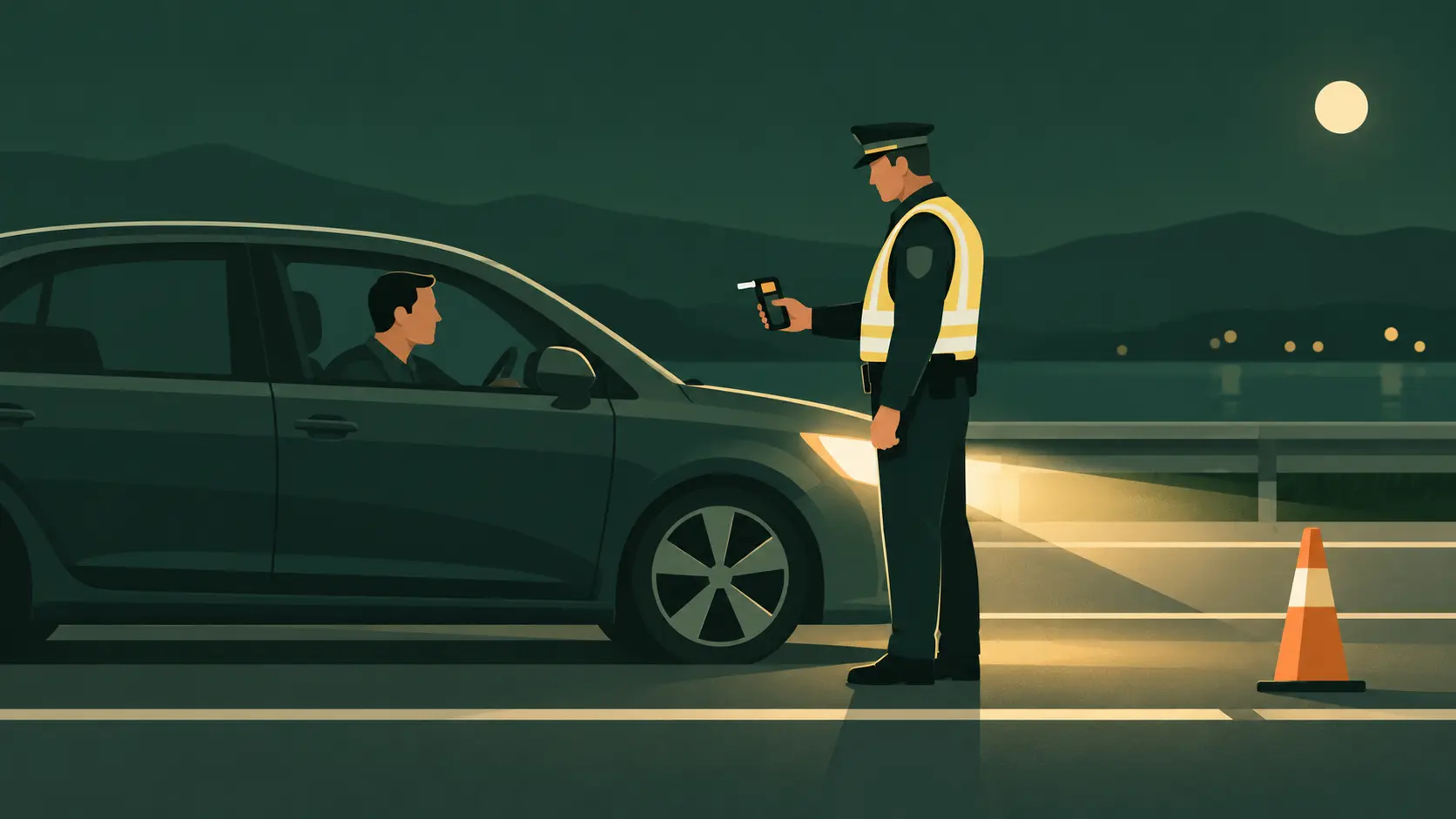
No, and the law is harsher than almost everyone assumes. Spain penalises the presence of THC in your body, not bad driving: a positive saliva test, confirmed by a laboratory, is enough for a 1,000-euro fine and the loss of 6 licence points, even if your driving was flawless. If the officers also note signs of impairment, the case goes to criminal court (article 379.2 of the Penal Code) with a possible prison sentence and a driving ban of one to four years. Refusing the test is always a criminal offence. And because THC can be detected in saliva for 24 to 72 hours after use, the risk does not end when the effects wear off. There is no legal threshold, as there is in the UK or Germany: in Spain, any confirmed amount counts.
This is the third article we have devoted to cannabis detection, and the one that generates the most questions at the club, especially from visitors with a hire car. The other two explain how long THC stays in your system and what happens with drug testing at work. This one closes the set with the scenario where a consumer has the most to lose: a roadside check.
We will look at exactly what the law says, how a DGT (Spanish traffic authority) check works step by step, which route a case follows depending on what happens at the roadside, what each scenario costs, which myths to forget and what happens to medical cannabis patients, whom the new Royal Decree left in no man’s land.
Important note: at Green City we do not promote the use of cannabis. We are a private, non-profit association of adults who are already consumers. This article is informative and preventive: knowing the consequences of driving with THC in your system is part of responsible consumption, and the only recommendation you will read here is that if you have consumed, do not drive.
In this article
- What the law says: presence is penalised, not impairment
- How the DGT saliva test works, step by step
- Which route does your case take? Administrative or criminal
- Penalties compared: fine, points, offence and refusal
- False myths about cannabis and driving
- Medical cannabis patients: the gap the Royal Decree left
- And in Seville? What this means for a member
What the law says: presence is penalised, not impairment
With alcohol the logic is familiar everywhere: there is a limit, and below it you may drive. With drugs there is no limit at all in Spain. Article 14 of the Traffic Act (Royal Legislative Decree 6/2015) prohibits driving “with the presence of drugs in the body”, and article 77 classes it as a very serious offence. Article 80.2 sets the consequence: a 1,000-euro fine, to which the points annex adds the loss of 6 points. It is the same punishment as exceeding the speed limit by more than 50 %.
The word that changes everything is presence. The authorities do not need to prove that THC affected your ability to drive, that you were weaving, or even that you consumed that day. It is enough for the analysis to confirm there was THC in your saliva. You can have smoked the previous afternoon, feel perfectly fine and still be fined. That explains why cannabis is, year after year, the substance that shows up most in DGT checks, well ahead of cocaine.
The numbers give a sense of scale: according to figures the Government provided in a parliamentary reply, close to 150,000 roadside drug tests were carried out in 2025 and more than 70,000 drivers received a final penalty with loss of points. In Andalusia the public prosecutor has recorded provinces where one in three tests came back positive.
How the DGT saliva test works, step by step
A drug check usually follows the breathalyser, at a preventive checkpoint or after an accident or an offence. It is a regulated procedure, and knowing it helps you understand both your rights and why the “tricks” do not work. Tap each step:
The officer informs you that you are obliged to take the test. It is not an invitation. Refusing is a criminal offence under article 383 of the Penal Code, with heavier penalties than a positive result itself. Any driver can be required to take it, including cyclists and e-scooter riders, and the officer does not need to notice any symptoms first.
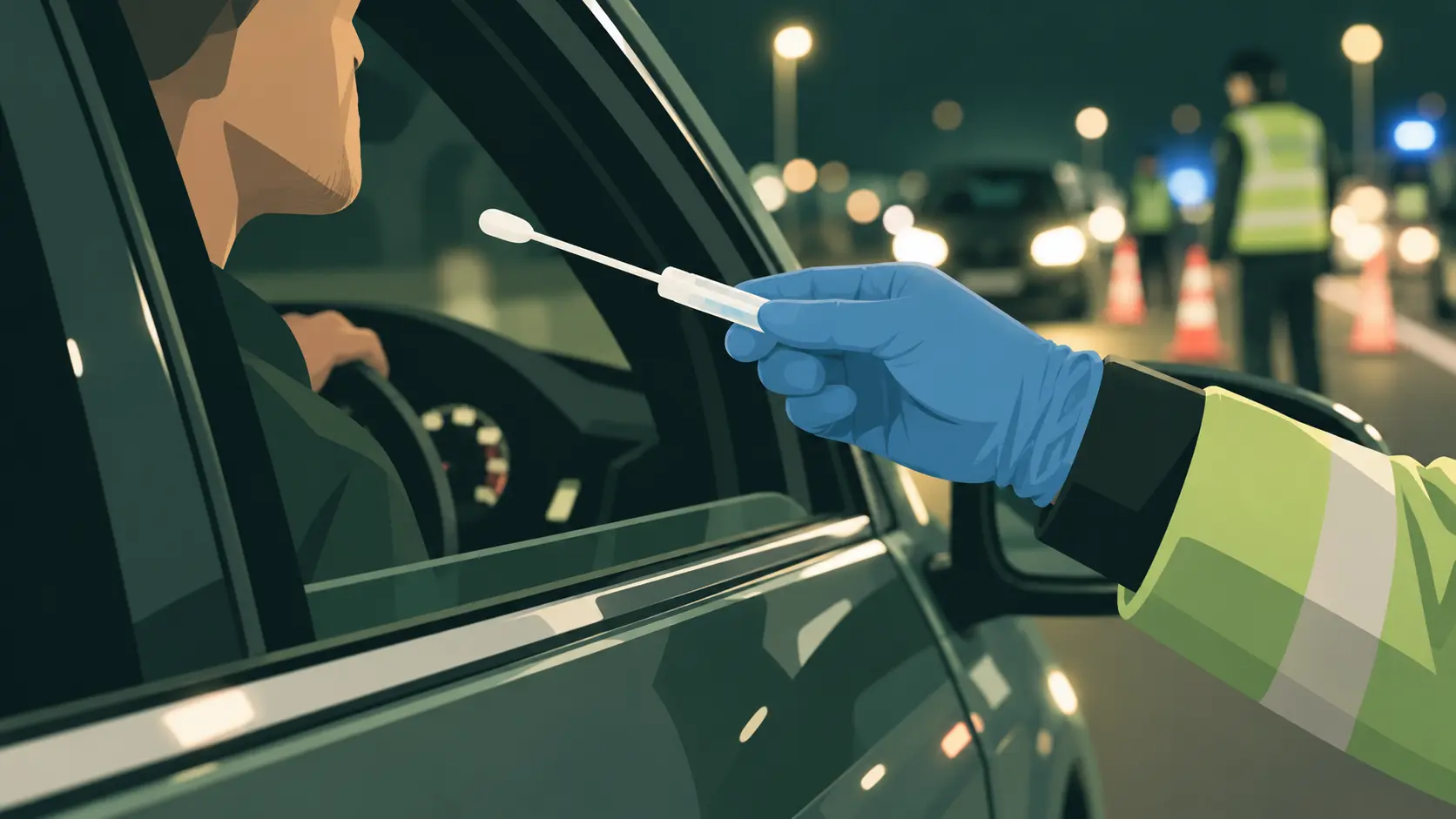
A saliva sample is taken with a portable device (the most common are the Dräger DrugTest 5000 and the DrugWipe) which within a few minutes indicates traces of cannabis, cocaine, amphetamines, opiates or benzodiazepines. The result is qualitative, positive or negative, with no quantities. For cannabis the device looks for active THC, not the THC-COOH metabolite that urine tests target, which is why its window is hours or a few days rather than weeks.
If the test is positive, a second saliva sample is taken and sent sealed to a laboratory. The roadside positive only opens the procedure: the penalty arrives only if the laboratory confirms it, usually weeks later. In the meantime you cannot carry on driving that day: the vehicle is immobilised unless someone else in a fit state takes over.
You have the right to request a blood test (article 14.5 of the Traffic Act), taken at a healthcare centre. If it comes back negative, the case is closed; if it confirms the positive, you pay for the analysis. It is a useful route when the driver is certain there is no active THC in their body, for instance after a consumption some days back.
With the laboratory report and the officer’s record, the route is decided. If there are no signs of impairment, an administrative case is opened (fine and points). If the officers recorded symptoms of impaired driving, the police report goes to court as a possible offence under article 379.2 of the Penal Code. We look at this in detail in the next section.
Saliva detects recent use, and “recent” means days
As a reference, THC is detectable in saliva for 24 to 72 hours after a one-off consumption, and longer in regular consumers. The effects, by contrast, last between 2 and 6 hours. The whole gap in between is positive-test territory with no feeling of being under the influence at all. The full ranges by test type are in how long THC stays in your system.
Which route does your case take? Administrative or criminal
A positive does not always end the same way. It depends on three things: whether you take the test, whether the laboratory confirms the result, and whether the officers note signs that cannabis was affecting your driving. Answer the questions to see where each scenario ends:
1. At the checkpoint, do you take the saliva test?
Straight to criminal court (article 383 of the Penal Code). Refusing the test is an offence in itself: six months to one year in prison and a driving ban of one to four years. It makes no difference whether you had consumed or not. It is, by a distance, the worst decision you can make at a checkpoint.
2. What does the screening test say?
You carry on. No positive, no case. It is the only scenario without consequences, and the only way to reach it is by leaving enough time without consuming before getting behind the wheel.
3. Do the officers note signs of impairment (red eyes, slow speech, erratic driving, smell in the car)?
Administrative route. The second sample goes to the laboratory and, if it confirms THC, the penalty follows: 1,000 euros (500 if paid within 20 days) and 6 points off your licence. You cannot keep driving that day. You can request the blood test and file an appeal.
Criminal route (article 379.2 of the Penal Code). The police report goes to court for driving under the influence of drugs: three to six months in prison, or a fine of six to twelve months, or 31 to 90 days of community service, and in every case a driving ban of one to four years. Here impairment does have to be proven, and the symptoms the officer recorded are the key.
Penalties compared: fine, points, offence and refusal
To have it all in one view, these are the three scenarios and what each one costs. A detail many people discover too late: the early-payment discount reduces the fine, but it does not give the points back.
| Scenario | Rule | Fine or sentence | Driving licence | What has to be proven |
|---|---|---|---|---|
| Confirmed positive with no signs of impairment | Arts. 14 and 77 Traffic Act (very serious offence) | €1,000 (€500 if paid within 20 days) | Loss of 6 points | Only the presence of THC in saliva |
| Driving under the influence | Art. 379.2 Penal Code | 3 to 6 months in prison, or a 6 to 12 month fine, or 31 to 90 days of community service | Ban of 1 to 4 years | Presence plus impairment of driving |
| Refusing to take the test | Art. 383 Penal Code | 6 months to 1 year in prison | Ban of 1 to 4 years | Only the refusal; no consumption needs to be shown |
To put the 6 points in context: an experienced Spanish driver holds between 12 and 15, but a new driver starts with 8, so a single positive leaves them two points from losing the licence. For visitors, a Spanish fine on a foreign licence does not remove points at home, but the fine is enforceable across the EU and the hire company will pass it on with its own admin charge. And whatever your licence, a criminal conviction and a driving ban apply to you in Spain just the same.
False myths about cannabis and driving
A considerable folklore has grown up around these checks, partly inherited from the logic of alcohol, which does not apply here. These are the myths that do the most damage:
“If I drive well, they can’t fine me”
Reality: they can. The administrative route penalises the presence of THC, with no need for it to affect your driving. Driving well only spares you the criminal route, not the fine and the points.
“I smoked yesterday, it won’t show any more”
Reality: the saliva test detects THC for 24 to 72 hours after a one-off consumption, and longer in daily consumers. “Yesterday afternoon” sits squarely inside the window.
“At home there’s a legal limit, so a little is fine”
Reality: the UK’s 2 µg/L threshold or Germany’s 3.5 ng/mL do not exist in Spain. The test is qualitative: any confirmed presence of THC is an offence, however small. Your home country’s rules travel with you no further than the border.
“With CBD I won’t test positive”
Reality: pure CBD will not, because the test is not looking for it. But many “CBD” flowers and oils contain traces of THC, and with frequent use they can cause a positive. We explain it in CBD in Seville.
“Better to refuse, then they have no evidence”
Reality: refusal is a criminal offence with six months to a year in prison, more serious than an administrative positive. It is the worst calculation you can make at a checkpoint. Chewing gum, water or mouthwash will not help either: nothing removes THC from saliva in the minutes of a check, and the lab sample is far more sensitive than the roadside device.
“HHC and ‘legal’ products don’t show up”
Reality: cross-reactivity with HHC is poorly documented, and since April 2025 it is a controlled substance like any other. We cover it in HHC and THCP: why they are banned in Spain.
Medical cannabis patients: the gap the Royal Decree left
Since October 2026 the first patients have begun receiving medical cannabis in Spanish hospitals on a specialist’s prescription. The obvious question follows: can someone on a prescribed treatment drive?
The Traffic Act contains a clause that usually goes unnoticed: article 14.1 excludes from the prohibition “substances used under medical prescription for therapeutic purposes, provided the driver is in a fit state to use the vehicle”. On paper, a THC preparation prescribed in a hospital fits that exception. The problem is that everything else is unresolved:
- The saliva test cannot tell prescribed THC from THC of any other origin. A patient will test positive all the same, and the case will be opened all the same.
- There is no DGT protocol setting out how to prove the prescription at the roadside, or which document counts. Royal Decree 903/2025 does not touch traffic law.
- The burden of proof falls on the patient, who will have to appeal with their hospital prescription and argue they were “in a fit state to use the vehicle”. Meanwhile, on the day of the check, the car stays immobilised.
- The exception only covers the administrative route. If there are signs of impairment, article 379.2 of the Penal Code provides no exception for medical treatment.
It is one of the loose ends flagged while the Royal Decree was being drafted, and it remains open. Until it is resolved, the advice for a patient is the same as for anyone else with THC in their body: do not get behind the wheel, and talk to your doctor about how to organise the treatment around driving. And a prescription from another country, as we explain in the medical cannabis article, carries no weight in Spain at all.
And in Seville? What this means for a member
For anyone who is a member of a club in Seville, or thinking about it, the logic of this article comes down to a few simple habits:
- To the club without a car. It is the golden rule, and it goes double for visitors with a hire car. Consuming in an association is legal because it happens in a private space, but the saliva detection window stays open for hours or days. Seville has a metro, a tram, buses and plenty of walkable routes; the club is eight minutes from Prado de San Sebastián. If you choose a bike or an e-scooter, remember that the ban on driving with drugs present applies to them too.
- If you are stopped leaving the club, stay calm and cooperate. Taking the test is compulsory and refusing is a criminal offence. On how to behave with the police near an association, see our specific guide.
- Nothing in your pockets or the glovebox. At a checkpoint officers may search the vehicle, and possession in a public place is a separate penalty from the driving one, with the fines we explain in the fine for carrying marijuana. Consuming inside the club removes the problem at the root.
- If you are travelling on, plan ahead. Driving out of Seville the morning after consuming is exactly the scenario that produces the most positives, and the airport road is a classic spot for checks. In travelling with cannabis in Spain we explain how to move around without needless risk.
- Questions get answered by asking. In a cannabis social club in Seville these things are discussed openly and with people who know the legal framework. Responsible consumption starts with knowing when not to drive.
A private space you can walk to, and leave without a steering wheel
FIND OUT HOW TO BECOME A MEMBERWe are at C. Bartolomé de Medina 24 (41004 Seville), an 8-minute walk from Prado de San Sebastián.
Frequently asked questions about cannabis and driving in Spain
The questions that come up most often, answered without the runaround.
What is the fine for testing positive for cannabis at a DGT checkpoint?
1,000 euros and the loss of 6 licence points, for driving with drugs present in the body (a very serious offence under the Traffic Act). Paying within 20 days of notification halves the fine to 500 euros, but the 6 points are lost regardless.
How long after smoking will a saliva test come back positive?
As a reference, 24 to 72 hours after a one-off consumption, and longer in regular consumers, although it varies with the person, the amount and the potency. The device detects active THC, so the highest risk is concentrated in the first 24 hours. The only safe way to test negative is to leave enough time without consuming.
Is there a legal THC limit for driving in Spain?
No. Unlike the UK, Germany or some US states, Spain has no threshold: the law penalises any confirmed presence of THC, and the roadside test is qualitative, positive or negative, with no quantities. A foreign licence does not change this.
What happens if I refuse the drug test?
It is an offence under article 383 of the Penal Code, punishable with six months to one year in prison and a driving ban of one to four years. It is more serious than an administrative positive, and it applies even if you had not consumed anything.
Can I request a blood test if I test positive in saliva?
Yes. Article 14.5 of the Traffic Act gives you the right to a blood test, carried out at a healthcare centre. If the result is negative the case is closed; if it confirms the positive, the cost of the analysis falls on the driver.
Can I drive if I have a medical cannabis prescription?
The Traffic Act excludes substances used under medical prescription for therapeutic purposes, provided the driver is fit to drive, but there is no protocol for proving it at the roadside: the saliva test will come back positive all the same and the patient will have to argue the point on appeal. If there are signs of impairment, the criminal route allows no exceptions. The advice is not to drive and to discuss it with your doctor. A prescription from another country has no effect in Spain.
The legal information in this article is based on Royal Legislative Decree 6/2015 (Traffic Act), the General Traffic Regulations and articles 379 and 383 of the Penal Code, in force on the date of publication; amounts and procedures may be updated. Detection times are indicative and come from ranges published in the scientific literature. This content is informative and does not constitute legal advice: if you are facing a case or a police report, consult a lawyer. Green City is a private, non-profit association for adults who are already consumers. We do not promote cannabis use: we encourage those who already consume to do so responsibly, consciously and within the law.